Sunday

Afghani

The Soul of Pashto

Embark on a journey through the vibrant language of the Pashtun people, a thread of culture and resilience.

A Language Born of the Mountains

پشتو

In the rugged heart of the Hindu Kush, where the wind carries tales of ancient warriors, the Pashto language was born. Spoken by the Pashtun people, Pashto is more than words—it’s the rhythm of tribal honor, the melody of poetry recited under starlit skies, and the voice of a culture that thrives in Afghanistan and northwestern Pakistan. With roots in the Eastern Iranian branch of the Indo-European family, Pashto dances across the tongues of 50 million souls, its script—a flowing variant of Perso-Arabic—capturing the spirit of a people bound by Pashtunwali, their code of hospitality and courage.

From the bazaars of Kabul to the valleys of Khyber Pakhtunkhwa, Pashto is a bridge between past and present, an official language in Afghanistan alongside Dari, and a vibrant force in Pakistan. Its verses have inspired poets like Khushal Khan Khattak, whose words still echo in the hearts of Pashtuns worldwide.

The Pashto Alphabet: Letters of Identity

Traditional Pashtun attire, a symbol of cultural pride
ا
A
/ɑ/
A
ب
B
/b/
B
پ
P
/p/
P
ت
T
/t/
T
ټ
Ṭ
/ʈ/
Ṭ
ج
J
/dʒ/
J
چ
Ch
/tʃ/
Ch
ح
Ḥ
/h/
Ḥ
خ
Kh
/x/
Kh
د
D
/d/
D
ډ
Ḍ
/ɖ/
Ḍ
ر
R
/r/
R
ړ
Ṛ
/ɺ/
Ṛ
ز
Z
/z/
Z
ژ
Zh
/ʒ/
Zh
س
S
/s/
S
ش
Sh
/ʃ/
Sh
ص
Ṣ
/s/
Ṣ
ض
Ḍ
/d/
Ḍ
ط
Ṭ
/t/
Ṭ
ظ
Ẓ
/z/
Ẓ
ع
‘
/ʔ/
‘

The Heartbeat of Afghanistan

Languages in Afghanistan

In Afghanistan, Pashto is the song of the south and east, resonating through the dusty plains and mountain passes. It’s the language of roughly half the nation’s people, enshrined as an official tongue alongside Dari in the country’s constitution. From Kandahar’s vibrant markets to the northern reaches, Pashto carries stories of resilience, woven into the fabric of daily life—whether in the rhythmic chants of a wedding or the solemn recitations of tribal elders.

Its words are a cultural anchor, preserving traditions like the hujra, where men gather to share poetry and resolve disputes, and the attan, a whirling dance that pulses with Pashtun pride. Pashto’s presence in Afghanistan is a testament to a people who have endured centuries of change yet hold fast to their linguistic heritage.

Pashto Across Borders

The Hindu Kush, cradle of Pashto

Across the border in Pakistan, Pashto thrives in the rugged landscapes of Khyber Pakhtunkhwa and the tribal areas, spoken by over 12% of the nation’s people. In Karachi, the world’s largest Pashtun community—some 7 million strong—infuses the city with the language’s vitality, from tea houses to music studios. Pashto’s cadence is heard in the bustling streets of Hyderabad and the quiet villages of Balochistan, a reminder of the Pashtun’s deep roots.

Beyond South Asia, Pashto whispers in the deserts of northeastern Iran and echoes in the hills of Jammu and Kashmir. It’s a language that travels with its people, carrying the scent of cardamom tea and the warmth of tribal gatherings to distant lands.

A Global Tapestry

The Pashtun diaspora has woven Pashto into the global tapestry, from the skyscrapers of Dubai to the quiet suburbs of London and New York. In the UAE and Saudi Arabia, Pashto speakers gather to celebrate their heritage through music and storytelling. Communities in Canada, Germany, and Sweden keep the language alive, teaching it to new generations who may never see the mountains of their ancestors. Pashto is a living legacy, a bridge across continents, uniting Pashtuns with the pride of their culture and the promise of their future.

Pashto is more than a language—it’s the heartbeat of the Pashtun soul, resonating from ancient mountains to modern cities worldwide.

Saturday

Ancient Greek

Ancient Greek Language Overview

Ancient Greek: Language, History, and Legacy

Text-to-Speech:

Ancient Greek is an Indo-European language spoken from the 14th century BCE to the 4th century CE. It shaped Western civilization through literature, philosophy, science, and law.

1. Mycenaean Greek (14th–12th centuries BCE)
Mycenaean Linear B Tablet

The earliest attested Greek, written in Linear B on clay tablets for palace records. Deciphered in 1952.

Sample Text

𐀷𐀙𐀰 wa-na-ka / 𐀨𐀐𐀯 ra-wa-ke-ta

wanax / lāwāgetās

"king" / "military leader"

Vocabulary

𐀷𐀙𐀰
wa-na-ka
wanax — king
𐀡𐀲𐀙
po-ti-ni-ja
potnia — lady, goddess
𐀒𐀵𐀊
ko-to-ni-ja
ktoiniā — landholding
Grammar: Preserves Indo-European dual, instrumental -pi, labiovelars (q-). Early noun stems.
2. Archaic Greek (8th–6th centuries BCE)
Homer Statue

Oral tradition → written epics. Greek alphabet invented (~800 BCE). Homer and Hesiod.

Sample: Iliad Opening

Μῆνιν ἄειδε, θεά, Πηληϊάδεω Ἀχιλῆος
οὐλομένην, ἣ μυρί᾽ Ἀχαιοῖς ἄλγε᾽ ἔθηκε...

Mênin áeide, theá, Pēlēïádeō Akhilêos
ouloménēn, hḕ myrí’ Akhaioîs álge’ éthēke...

"Sing, goddess, the wrath of Achilles, son of Peleus,
the accursed wrath which brought countless pains upon the Achaeans..."

Vocabulary

μῆνις
mênis
divine wrath
ἑλώρια
helṓria
spoils
κύων
kýōn
dog (insult)
Grammar: Dactylic hexameter, digamma (ϝ), dual number, tmesis.
3. Classical Greek (5th–4th centuries BCE)
Parthenon

Golden age of Athens: democracy, tragedy, philosophy. Attic prose dominates.

Sample: Aeschylus, Agamemnon

Ὦ προστάτις καὶ σύντροφος Ἑλλήνων...
ὄλβον ἤλασας ἀνδράσιν...

Ô prostátis kaì sýntrophos Hellḗnōn...
ólbon ḗlasas andrásin...

"O guardian and companion of the Greeks...
you drove prosperity to men..."

Vocabulary

προστάτις
prostátis
patroness
ὄλβος
ólbos
prosperity
ἄεθλον
áethlon
prize
Grammar: Attic -ᾱ → -η, contract verbs, optative, participles.
4. Hellenistic & Koine Greek (3rd BCE – 4th CE)
Alexander Mosaic

Greek becomes world language after Alexander. Koine used in Bible, papyri.

Sample: Callimachus

Εἰδώλοισιν ἀμήχανον οἶκτον...
ἑκάεργον ἔρως...

Eidṓloisin amḗkhanon oîkton...
hekáergon érōs...

"It is impossible to pity phantoms...
love that keeps afar..."

Vocabulary

εἴδωλον
eídōlon
image, phantom
ἀμήχανος
amḗkhanos
helpless
Ἀμαζών
Amazṓn
Amazon
Grammar: Simplified: no dual, rare optative, periphrastic tenses.

Friday

Swiss German


In all German-speaking countries there is a bilingualism where official German is spoken alongside the local German dialect.The same is true in Switzerland with Swiss German (Schwyzerdütsch).

German speaking areas in Switzerland.


German dialects in Switzerland are spoken by the German-speaking population in both urban centres and in the countryside.

 Linguistically they are not uniform and in fact many of them are more closely related to German dialects outside the country than to each other, especially to dialects of Liechtenstein, Austria and Italy and France.


 The reason they are classified together is for political rather than linguistic reasons.Linguistically they are classified in the Alemannic Germanic dialects,the lower,middle and high Alemannic dialects in the Alps.

Compared to the official German of Germany, they have big differences that create a big problem in communication.Imagine that Swiss films shown in Germany are either subtitled or dubbed.

The official language of the German-speaking cantons is official German in its Swiss version which is taught in school and at first is almost a foreign language for children because of its difference from the local German dialect.


Apart from official documents,administration and commerce official German is also used in news reports.Official Swiss German is also closer to the German of Germany.

On a more informal level, e.g. on the internet, in colloquial speech, at home and on television in shows such as serials and soap operas, the local dialect is preferred.But don't imagine that the local dialects are snubbed as they are here in Greece.There they are spoken alongside official German not only without shame, but on the contrary with pride.

Some particular features of Swiss dialects are vowel clusters,different vocabulary depending on the region and loans from French and less so from Italian.For example, thank you in Switzerland is merci while in Germany it is danke.


sample of the language.

Was koschtet das? How much does it cost?
Z'tüür!
Das isch mir e chli z'tüür .This is rather expensive.

Tuesday

Romanian days of the week.


Luni
Monday   

Joi
Thursday

Marţi
Tuesday   

Vineri
Friday   

Duminică
Sunday

Miercuri
Wednesday   

Sâmbătă
Saturday


Zi
Day

ziua
ζίουα
the day

zile
the days

ce zi este azi?
What day is it today?

Azi este...
Today is..

astăzi / azi
Today

ieri
Yesterday

mâine
Tomorrow 

săptămâna asta
This week

săptămâna trecută
Last week

săptămâna viitoare
Next week

Exercise

Saturday 

Tuesday 

Friday 

Monday 

Sunday 

Wednesday 

Thursday 

Count Dracula's language.

The Romanian alphabet is a variant of the Latin alphabet and consists of 31 letters.

The letters Q (read kü or chiu), W (dublu ve), and Y (igrek=i Greek, or i grek) were officially introduced in 1982, but were unofficially used earlier.


They are only found in foreign words such as quasar, watt, and yacht. The letter K, although relatively older, is rarely used and is still considered foreign due to the fact that it only appears in nouns and international neologisms such as kilogram, broker, karate.

 In cases where we have words which are borrowed directly from other languages  and they are used diacritics  ,the official spelling encourages their use. (München, Angoulême,etc but Istanbul instead of İstanbul).

A, a a
Ă, ă ă
Â, â â 
B, b be
C, c ce
D, d de
E, e e
F, f fe / ef
G, g ghe / ge
H, h ha / haş
I, i i
Î, î î , like Turkish ı
J, j je ,  like zh
K, k / kapa
L, l le / el
M, m me / em
N, n ne / en
O, o o
P, p pe
Q, q kü / chiu 
R, r re / er,ρ
S, s se / es
Ș, ș / Ş, ş șe / şe   like sh
T, t te
Ț, ț / Ţ, ţ țe / ţe    like ts
U, u u
V, v ve, 
W, w dublu ve
X, x ics
Y, y igrec / i grec
Z, z ze / zet


The Romanian language 


Romanian or Limba Romane (limba română) is a Romance language like Italian, French and Spanish but retains more archaic features of Latin that its other descendants have lost.

It was the native language of Vladimir Chepes aka Count Dracula or Vlad the Impaler. He was a bloodthirsty Bohemian of Wallachia and had a deadly hatred for the Turks.  It is said that he had skewered over twenty thousand.

That's where the myths about Count Dracula drinking the blood of men came from.

Vlad Ţepes the Impaler or Count Dracula, voivod of Wallachia.

Along with Istro-Romanic, Vlach (Armanic, Romance and Moghlenic) is a branch of the Balkan neo-Latin languages.It is spoken by 24-28 million people, mainly in Romania and, according to some, in Moldova.

Romanian in MoldovaIn Moldova, the language is called Limba Maldovanese.According to a significant part of the Moldovan population, Moldavian is a separate language.


The differences with Moldavian are real but not so significant that there is a major divergence.For more on this read about the Moldavian language.

Relationship of Romanian with Vlach (Armanic,Romance,Moglenitic) and Istro-Romanian.Some linguists,mainly Romanians,argue that Vlach and Istro-Romanian were split off from Romanian (Dacorumanian) ,but this is not true since both are autonomous neo-Latin languages,sister languages that originated from the Eastern Balkan Roman mother tongue.

It is speculated that the cradle of Eastern Balkan Roman is the Roman province of the Dardanian Administration, south of the Danube.


From there, the neo-Latin Balkan languages broke away and each followed its own path.

An important difference between them is their borrowed vocabulary; Romanian has many Slavic words, while Vlach has many Greek words.

They share a common Latin vocabulary which in many cases is rather more archaic in Vlach.In syntax and grammar they are similar but Vlach completely lacks infinitive ,a feature that places it clearly in the southern Balkans along with Greek.


The first part of the Balkans to be conquered by the Romans was Epirus.The region of Dacia (present-day Romania) was conquered a century later.So it is logical that Latin-speaking started from the south and then expanded northwards, not the other way round as Romanian linguists claim.

vocabulary 

The vocabulary of Romanian has been heavily influenced by Slavic, with the percentage of Slavic loans reaching 30 percent. Old Romanian had even more Slavic words and phrases which were replaced by Romanian words and phrases. For example, the Slavic phrase i pak ,and so, was replaced with şi apoi.

60 percent are Latin words, while the rest are words from Turkish, Greek, etc.Of the Latin words, many are French.French is the most popular foreign language in Romania.


Is it hard to learn Romanian?
No, it isn't that hard . According to the Foreign Service Institute (FSI) anyway.

Romanian is classified as a first Category language for English natives to learn regarding its difficulty. 

In Category I there are the languages which are closely related to English.

While Romanian is a Romance language and English is a Germanic language Romanian can rather easily be learned because of the fact that English has a huge vocabulary of Latin origin ,about 60% or more,via Latin directly or Norman French.


Read also

Monday

Chinese

Have you ever come across a language where verbs have one form and do not change according to time, number or inflection?A language that has no cases, genders and nothing agrees with anything else?Have you ever tried a language where you have to sing it to be understood?
From top to bottom: left old script, right simplified script.

Chinese (Hangyu) is the most spoken language in the world in terms of number of speakers with over a billion speakers.That's one sixth of the world's population speaking Chinese.

Listen to Mandarin, the official dialect.


dialects

Actually Chinese is not one language but a group of Chinese,Sinitic dialects/languages which in most most cases are completely different from each other.

Main dialects are Mandarin (800 million speakers),Wu (90 million),Cantonese (70 million) followed by Min (50 million).


The Chinese consider all these languages to be dialects of one language, the single Chinese language, but there are some linguists who do not agree with this and consider them to be separate languages.


the Chinese dialects
and other languages of China
When we say Chinese we usually refer to Mandarin, the official and standard language of the Chinese state which is based on the Beijing dialect and is called putonghua (the common language).

Listen to Cantonese, the native language of Chuckie Chan.


Another popular dialect is Cantonese which is also spoken in Hong Kong.The Kung Fu movies of the 80's ,which were filmed in Hong Kong, are in Cantonese.By the way, Chuckie Chan's mother tongue is Cantonese,who besides that speaks Mandarin and English.


grammar and intonation.

The grammar of Chinese is quite simple compared to the grammars of Western languages since it has no cases,endings,genders,words do not change based on time,etc.Words are usually monosyllabic and disyllabic.

Chinese is a tonal language,unusual for western languages and has four stresses.That is,the same word has different meanings because it is stressed differently:

1st tone: ma1 or mā mother
2nd tone: ma2 or má  
3rd tone: ma3 or mǎ horse
4th tone: ma4 or mà argue


alphabet

The Chinese alphabet has nothing to do with the concept of an alphabet as we know it in our language.Our alphabet has 24 phonetic symbols, while the Chinese alphabet has no letters but ideograms, each of which has a different phonetic value and there are thousands of them.For example, to be able to read a Chinese newspaper with relative ease, one must know 2 to 3 thousand ideograms.

A Latin-based alphabet is also used to write the Chinese language, with the use of symbols or numbers next to the letter to represent the Chinese tones, which is called pinyin.Pinyin is also taught in the early grades of school, alongside the ideograms, since it is simpler and more accurate.

Sunday

Tibetan

The Tibetan alphabet was created in the 7th century A.D. and is based on Indian alphabets of the time.The emperor of Tibet sent a minister, Thonmi Sambhota, to India to gather information about Buddhism.

On his arrival in India,he did not confine himself to simply gathering information but using the region's model alphabets,such as the devanagari,he created the first script for Tibetan,which he brought home with him.


The script has two forms, one used in the press, books, newspapers etc and a handwritten one which is the daily script of the Tibetans.

Today the writing does not reflect the spoken language because the pronunciation of the Tibetan language has changed.


The official Tibetan language is based on the dialect of Lhasa ,the capital of the Tibetan Autonomous Chinese Province and is called Utsang. 


Utsang together with the dialects Amdo and Ham form the Tibetan language family. 


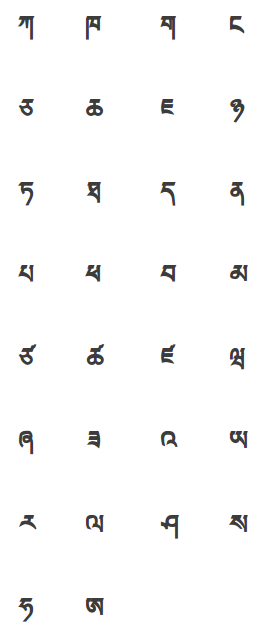
ཀཁགང
kakhaja
ngha

ཅཆཇཉ
cachayaña
ཏཐདན
tathadana
པཕབམ
paphabama
ཙཚཛཝ
tsatshayava
ཞཟའཡ
zhaza'aya
རལཤས
ralashasa
ཧཨ

haa


Here you can find tibetan fonts.

Illyrian


Illyrian was an Old Balkan language which belonged to the Indo-European homolingualism. It was spoken in the western Balkans by Illyrian tribes in a geographical area extending from the north of the Adriatic to Epirus and Macedonia.

The data we have on the language are scarce and therefore it is difficult to draw firm conclusions about its characteristics and its relationship with other languages.


characteristics of the language
To date no text has been found in Illyrian and our knowledge of the language consists of short inscriptions, only four words mentioned as Illyrian in various Greek and Roman sources, and a number of toponyms, personal names, ethnonyms and hydronyms. A very well known place name of Illyrian origin is 'Bosnia' which takes its name from the homonymous river Bosna (hydronym).In Illyrian Bosona means running water.

Linguistics has not yet come to a conclusion whether it is a Kendum or Satomic language.There is evidence in favour of one or the other category.

One feature of the phonology of the language that is accepted is the modification of Indo-European *bh to b and *dh to d. The same feature is recognized in the lexicological evidence we have for the ancient Macedonian language where b,d,c are found instead of f,i,h in most Greek dialects (Vereniki instead of Fereniki).

relationship with other languages

Its relationship with other ancient languages has not yet been proven.The claim that Albanian is a descendant of Illyrian is based on very inconclusive evidence and remains a theory promoted mainly by Albanian scholars.

The theory that Albanian originated from Dacian , a region of the central Balkans seems more likely.

 Nevertheless, in Albanian and Illyrian there are homonyms,such as mal (il,alb)=mountain,ren (il),re (alb)=cloud.

The naval vocabulary of Albanian is borrowed from other languages, mainly Latin,which supports the theory that Albanian originated from the mainland.

Illyrian seems to have many homonyms with Slavic languages as well.

Some scholars classify Illyrian languages and Messapian among the Illyrian languages, but such a categorization is not accepted by everyone today and there is a great deal of disagreement on this issue.

Albanian and Romanian

Romanian has a substrate vocabulary of a previously spoken language of about 100 words. Almost all of these words are also found in Albanian.

This means that the ancestors of Albanians and Romanians originally lived in the same place and either borrowed words from each other or spoke the same language.

The Roman administration of Dacia in the central Balkans.


Thraco-Illyrian

The theory that Illyrian might be connected to Thracian has been proposed,too. Whether it was a dialect or a closely related language it is debated. It has also been categorised as part of a Thraco-Illyrian dialect continuum with Thracian in one side of the continuum and Illyrian on the other.


There is now strong linguistic evidence that the original cradle of the Albanians and Romanians was the Dacia administration in the central Balkans.

These conclusions of the linguists do not, of course, coincide with the national myth of the Albanians.

Cypriot Greek

Note: Click the speaker icon to hear the pronunciation. Clicking the same or another speaker icon while audio is playing will stop it immediately. 🔊

Introduction 🔊
🔊 Listen to the entire section

Cypriot Greek (Κυπριακή διάλεκτος) is a distinct, vibrant variant of the Greek language spoken natively by the vast majority of Greek Cypriots on the island of Cyprus. While it is mutually intelligible with Standard Modern Greek (SMG) to varying degrees, it possesses a completely unique phonetic layout, syntax patterns, and an extensive vocabulary influenced by centuries of geopolitical shifts. 🔊

What fascinates linguists globally is how Cypriot Greek manages to function simultaneously as an informal vernacular and a core pillar of local identity. It bridges ancient heritage with modern Mediterranean life, offering an expressive window into the soul of the island. 🔊

Cypriot Culture

Image depicting traditional and modern elements of Cypriot culture.

Origin 🔊
🔊 Listen to the entire section

The evolutionary tree of Cypriot Greek traces back deeply into antiquity. It shares direct structural lineages with the ancient Arcadocyprian dialect of the Peloponnese, which was brought over to Cyprus by ancient Greek colonists centuries before the classical era. 🔊

Throughout subsequent millennia, the island experienced successive waves of rulers—including the Romans, Byzantines, Franks (Lusignans), Venetians, Ottomans, and British. Each era left unique linguistic marks. However, the foundational core remained predominantly medieval Byzantine Greek, insulating the dialect from certain modern mainland shifts and preserving fascinating linguistic fossils. 🔊

Cypriot Artifacts

Historical archaeological artifacts bearing early linguistic inscriptions.

Characteristics 🔊
🔊 Listen to the entire section

Speaking or listening to Cypriot Greek reveals distinct phonetic features that separate it immediately from Standard Modern Greek:

  • Geminate (Double) Consonants: Pronouncing certain consonants with extra length or emphasis (e.g., *ψάλλω* or double sounds like *τσια*). 🔊
  • Palatalization: Sounds like /k/ and /g/ often transform into /tʃ/ (like "ch" in chess) or /dʒ/ (like "j" in jam) before front vowels. 🔊
  • Archaic Endings: Retention of specific noun endings and verb conjugations lost in standard speech. 🔊
Cypriot Culture

Visual representation of regional Cypriot linguistic nuances.

Historical Use 🔊
🔊 Listen to the entire section

Historically, written records in medieval Cypriot Greek—such as the famous chronicles of Leontios Makhairas—demonstrate that the dialect was prestigious enough to record the island's legislative, political, and cultural histories during the Frankish period.

In modern history, Cypriot Greek served as the everyday unifier across villages and towns. While Standard Modern Greek dominates formal education, official broadcasting, and literature, Cypriot Greek remains the definitive marker of intimate, domestic, and community bonds. 🔊

Vocabulary 🔊
🔊 Listen to the entire section

The vocabulary of Cypriot Greek contains unique words that do not exist or mean something completely different in Standard Modern Greek. 🔊

Εν

Meaning: No / Is not
Standard Greek: Όχι / Δεν είναι
🔊

Πούποτε

Meaning: Nowhere
Standard Greek: Πουθενά
🔊

Τσιατσί

Meaning: Glass / Cup
Standard Greek: Ποτήρι
🔊

Κοπελούδιν

Meaning: Young child / Kid
Standard Greek: Παιδάκι
🔊

Τσιάκκος

Meaning: Stone / Rock
Standard Greek: Πέτρα / Βράχος
🔊

Aχούrin

Meaning: Barn / Stable
Standard Greek: Στάβλος
🔊

Common Phrases & Idioms 🔊
🔊 Listen to the entire section

Mastering everyday conversational Cypriot requires knowing popular idioms and greetings used across the island. 🔊

  • Greeting: Τί κάμνεις ρε πελέ μου, ούλα καλά?
    Meaning: What are you doing, my friend, all is well? 🔊
    Standard Greek: Τι κάνεις ρε φίλε μου, όλα καλά;
  • Asking how someone is: Πώς τα πάεις; Τι χαμπάρια;
    Meaning: How are you getting on? What's the news? 🔊
    Standard Greek: Πώς τα πας; / Τι νέα;
  • Expressing surprise: Άτε ρε! Αλήθεια;
    Meaning: Come on! Really? 🔊
    Standard Greek: Έλα ρε! / Σοβαρά;
  • Showing hospitality: Έλα να πιάσουμεν έναν καφέ.
    Meaning: Come grab a coffee with us. 🔊
    Standard Greek: Έλα να πιούμε έναν καφέ.
  • Reassuring: Εν πειράζει, ούλα εντάξει.
    Meaning: It doesn't matter, everything is fine. 🔊
    Standard Greek: Δεν πειράζει, όλα εντάξει.
  • Expressing haste: Πιάνω τον δρόμον τζαι τρέχω.
    Meaning: I am hitting the road and running. 🔊
    Standard Greek: Παίρνω τον δρόμο και τρέχω.
  • Checking in: Πού είδεσαι τόσον καιρόν;
    Meaning: Where have you been all this time? 🔊
    Standard Greek: Πού έχεις χαθεί τόσον καιρό;
Current State 🔊
🔊 Listen to the entire section

Today, Cypriot Greek enjoys immense vitality. While globalization and media exposure to Standard Modern Greek have influenced speech—especially among younger generations in urban centers—the dialect continues to evolve dynamically rather than fade away. 🔊

It is proudly used in modern literature, popular music genres, television comedies, and social media platforms, proving that local heritage adapts seamlessly to the digital age. 🔊

Learning Cypriot Greek 🔊
🔊 Listen to the entire section

Learning the dialect happens organically through local immersion, listening to regional music, and practicing daily phrases with native speakers. Examine the key phrase below. 🔊

Example: Το πουλίν επέτασε

Cypriot Greek: Το πουλίν επέτασε 🔊

Literal Translation: The bird has flown

Quiz 🔊
🔊 Listen to the entire section

Test Your Knowledge!

What major historical layers influence Cypriot Greek...

Punic language (Carthaginian)


Carthaginian or Punic was a Semitic language derived from Phoenician.It was spoken mainly in Carthage, present-day Tunisia and on the islands of the western Mediterranean by Carthaginians and Berbers.It is known to us from inscriptions, human names and references to Roman writers.

What we know about them
In some works by Roman writers, such as Plautus' Poenulus, phrases in Carthaginian are mentioned.Today there is great interest in them and linguistic studies and research are being carried out.Unlike the Carthaginian inscriptions which only marked vowels, these few phrases also mark the vowels, a fact of great importance for the reconstruction of Carthaginian.

The last great Roman poet who seems to have known Carthaginian was Augustus of Hippo,who lived hundreds of years after the destruction of Carthage in 400 AD.It seems that the language survived even then.

the Carthaginian empire at its height 


the Carthaginian alphabet
Chronologically it is divided into two periods the old one which was used only on monuments and the so-called Neo-Carchidonian which was more calligraphic and used for other purposes.It originated from the Phoenician alphabet.


Carthage history. 
According to ancient traditions Carthage was founded in 300 BC by Phoenician colonists from Tyre, that's why the city was called New Tyre in Aramaic.

The Carthaginians were the greatest enemy and competitor of the Romans with whom they fought three wars called the Carthaginian wars until the conquest and destruction of Carthage by them.

Hannibal crossing the Alps into Italy


Hannibal,the greatest Carthaginian general,starting from the Carthaginian possessions in Spain,proceeded along the coast,crossed the Alps with his army and elephants and reached northern Italy.

There he won important victories against the Romans threatening Rome itself.He was finally defeated by the Roman general Scipio the African.


At its peak, the Carthaginian kingdom extended over the entire northwest coast of Africa, Sardinia, Corsica, western Sicily, the Balearic Islands and southern Spain, as well as Malta, as shown by Carthaginian inscriptions. 

The discovery of these inscriptions has led some linguists to argue that modern Maltese is derived from Carthaginian, which of course is not true since Maltese is derived from Sicilian-Arabic and has many, many Italian words.

Related posts

FOLLOW ME

Search This Blog

Translate

Recent comments

Followit

Popular