Nahuatl (pronounced Náhuatl), meaning 'the pure language', is a language spoken by 1.5 million people in Mexico.
It is a descendant of the language spoken by the Aztecs, Toltecs and perhaps the people of the city of Teotihuacan and was the lingua franca of the Aztec empire in Mesoamerica from the 7th century AD until the Spanish conquest in the 16th century.
After the fall of the Aztec empire,various dialects of Nahuatl began to emerge.
Today people who speak different Nahuatl dialects do not always understand each other.
Aztec Empire
The dialect of the Mexico Valley is closer to the classical Nahuatl of the Aztecs.
Classical Nahuatl was written using a pictographic system and was not a complete writing system but rather served the role of a mnemonic aid to enable the Aztecs to recite texts orally.
The Spaniards with their arrival introduced the Latin alphabet,when the systematic recording of works began.
With the arrival of the Spanish in Central America, Nahuatl lost its place as the dominant language of the region and many books were burned as they were considered pagan.
However, the number of speakers of the language did not decrease but instead increased, which was due to the Spanish making alliances with Nahuatl-speaking tribes.
Nahuatl speakers became key allies of the Spanish and served in the Spanish army by the thousands, resulting in the expansion of Nahuatl much further south into the Americas.
In fact Nahua soldiers made up the bulk of the Spanish forces that occupied the Philippines and even today Chavacano, a creole-based Spanish language spoken in the Philippines, has many Nahuatl words.
The language was later used by the Spaniards as a lingua franca and flourished with the production and translation of many books in Nahuatl, such as grammars, dictionaries and works of literature and poetry dating back to the 16th century AD, a unique phenomenon for an Indian language.
Many Nahuatl words passed into European languages mainly through Spanish; the words tomato, chocolate, tequila, chilli are Aztec Nahuatl words.
the alphabet
A variant of the Latin alphabet introduced by the Spanish after the conquest of Mexico is used to write Nahuatl.
It consists of twenty-five letters:
a c ch cu e hu i l* m n o p qu t tl tz x y z ā ē ī ō ll* h*
Dravidian is a group of about eighty-five related languages spoken mainly in Southern and to a lesser extent in central India by about 220 million people.
The most widespread languages of the group are Telugu,Kannada,Tamil and Malayalam,all of which are found in South India,while Tamil also extends into northern Sri Lanka.
Dravidian languages
where they are spoken
Apart from South India, Dravidian extends to some areas in the central country while the Brahui language (750 thousand) is spoken in Pakistan and along with Dangar is the only Dravidian spoken exclusively outside India.
Dravidian is also spoken by communities abroad in Iran, Nepal, Afghanistan, Bangladesh, Malaysia and Singapore.
Dravidian is considered indigenous to South India,but its influence on the Indo-Aryan people of the north suggest that it was formerly spoken over a more extensive area.
The presence of the large Brahui community in Pakistan is problematic in relation to the traditional view that the Dravidians came from southern India.
Earlier Dravidian must have been more widespread in the Pakistan and Iranian region and it is speculated that Dravidian languages were spoken in ancient Elam.
Nostratic theory and classification
Related to all this is the theory that Dravidian came from the west ,from the Mediterranean region,thousands of years before the arrival of the Indo-Aryans.
This view coincides with the Nostratic theory which holds that all Dravidian, Indo-European, Uralic and Semitic languages came from a common ancestor of the Palaeolithic era, the so-called Proto-Nostratic language.
This conclusion was drawn from the many similarities in vocabulary, grammar between distant languages and common customs and traditions among many peoples.This theory is not very strong and is considered rather fringe at least for the moment until new evidence comes to light.
The prevailing theory at present is that the Dravidian language family is independent and unrelated to the Indo-Aryan languages of northern India which are classified as Indo-European.
influences
However, despite the impossibility of tracing the path that relates Dravidian to Western languages,many Indo-European loans are observed in the Dravidian vocabulary and fewer grammatical ones.
On the contrary, Dravidian grammatical phenomena abound in Indo-European languages while lexical borrowings are fewer.These phenomena are particularly observed in the comparison of Dravidian with Sanskrit.
Concerning vocabulary I detected a very curious similarity in some words such as the word helios in Greek, el , god in Hebrew and el the sun in Telugu; also 'nir' is water in many Dravidian languages νερό (nero) water in Greek.
Bosnian is a South Slavic language spoken in Bosnia and Herzegovina.
It originated from Serbo-Croatian from which it has some relatively minor local differences.
It was declared an independent and autonomous language after the break-up of Yugoslavia in the 1990s.
Where Bosnian originated.
In Yugoslavia all the local language variants that existed in Serbia, Bosnia, Croatia and Montenegro were deliberately ignored and considered one language, Serbo-Croatian.
The differences were of course minor and they were not different languages but different dialects with local variations.
In each region the language had some special features, for example in some words or pronunciation, which gave the local connotation to the common language.
In light green the areas where Bosnian is spoken.
The break-up of Serbo-Croatian and the subsequent emergence of four new languages derived from it after the break-up of Yugoslavia was due to political rather than linguistic reasons.
Since then, conscious efforts have also been made to linguistically distance the new languages from each other.
Of course, for the time being to no avail since, as I said, they are essentially the same language and this cannot be done overnight.
Differences with Serbo-Croatian
Historically, the differences with Serbo-Croatian are mainly words of Arabic origin related to Islam as well as differences in pronunciation, such as the ξ phoneme typical of Bosnian colloquialisms.
There are also some differences in grammar and morphology.
Bosnia and Herzegovina
speakers and writing
Bosnian has been the official language of the Republic of Bosnia and Herzegovina since 1994 and is spoken by about 2.2 million people.
It is written in the Cyrillic alphabet and also in the Latin alphabet; the same bilingual system prevails in Serbian.
An Arabic-based alphabet has also been developed for Bosnian, since Bosnians are Muslims, but it is not officially used.
The oldest South Slavic text dates back to 1189 and is written in Bosnian.
These are titles of property and were written by Ban Kulin in the Bosnian Cyrillic alphabet.
Name
Bosnian is called Bosanski (bosanski / босански) after the province of the same name in Bosnia.
Note that the word Bosnia is believed to be of Illyrian origin,one of the few Illyrian words known to date, and means 'river'.
sample of the Bosnian language
Bosanski jezik spada u vrstu tonskih jezika koji se u lingvistici nazivaju: jezici sa tonskim akcentom, a za njega je karakteristično postojanje dva tona (silazni i uzlazni) i dvije vokalne dužine (kratak i dug vokal). Jednosložne riječi mogu imati samo silazni ton, mada im vokal može biti i kratak i dug.
Eteo-Cypriot was a pre-Hellenic language spoken in Cyprus during the Iron Age, representing the indigenous linguistic heritage of the island before Greek colonization. The term "Eteo-" means "true" and refers to the native, non-Greek languages of the region, similar to "Eteocretan" used in Crete.
Eteo-Cypriot inscription from Amathus, Cyprus.
Eteo-Cypriot was spoken in Cyprus during the Iron Age, predating the arrival of Greek colonists. From the 10th century BC, it faced increasing pressure from Arcadocyprian Greek, the language of Greek settlers, and gradually declined until its extinction by the 4th century BC. The language's origins remain mysterious, with some linguists suggesting connections to the Lemnos inscription or Etruscan, while others propose links to Semitic languages. However, these theories lack conclusive evidence due to limited surviving texts.
Ruins of Amathus, Cyprus.
Eteo-Cypriot was written using the Cypriot syllabary, a script distinct from the Greek alphabet. It is speculated that this syllabary evolved from the Cypro-Minoan syllabary, itself a variant of Minoan Linear A. The script is known from a small number of inscriptions, some of which are bilingual, featuring both Eteo-Cypriot and Greek texts.
Example of the Cypriot syllabary used in Eteo-Cypriot inscriptions.
The most notable Eteo-Cypriot inscription is a marble slab discovered in 1913 at the acropolis of Amathus, dating to around 600 BC. This bilingual inscription includes both Eteo-Cypriot and Attic Greek, providing valuable insights into the language. Other inscriptions are scarce, limiting our understanding of Eteo-Cypriot vocabulary and grammar.
Representation of the Amathus acropolis, where the bilingual inscription was found.
The nature and origin of Eteo-Cypriot remain enigmatic due to the scarcity of surviving texts. While some scholars propose links to languages like Etruscan or Semitic, these hypotheses are unconfirmed. The language is primarily known through a few inscriptions, and its connection to the Cypro-Minoan syllabary suggests a deep-rooted indigenous tradition, but further evidence is needed to clarify its linguistic affiliations.
Vandalic was the language of the Vandal people and was spoken in Spain and North Africa.
For this language we have little evidence, a few Vandal names from Spain and only three Vandal phrases mentioned in works written in Latin, one of which is probably the beginning of the prayer 'Lord, have mercy'.
From this scanty evidence at our disposal some conclusions have been drawn about the phonology of the Vandal language and its classification; it belongs to the East Germanic branch and was very closely related to Gothic.
Linguists speculate that Vandalic, Gepidic and Gothic were very closely related languages to each other, all of which were known as Gothic in their day.
Some Vandalic phrases that we know of:
Eils!
Scapia matzia ia drincan!
Froja armes - Sir, have mercy.
The Vandals were a Germanic people originally from the Scandinavian peninsula; they subsequently crossed over to the opposite Baltic coast and settled in present-day Poland.
In the 5th century AD the Vandals began to invade the western Roman Empire, crossing the entire Gaul and killing and pillaging their way to the Iberian Peninsula where they established Vandal kingdoms in what is now northern Portugal and southern Spain.
They later migrated to the opposite coast, conquering the Roman province of North Africa and the Apennine Islands, the Balearic Islands, Sardinia, Sicily and Corsica.They posed a serious threat to the Romans and even conquered and sacked Rome itself in 455 AD.
Their kingdom survived until the middle of the 6th century when the Byzantine general Belisarius sent by emperor Justinian captured and annexed Vandal North Africa in the so-called Vandal Wars in just five months ending their existence.
Their name became synonymous with destruction and pillage.
The Vandals were Christians who believed in the Arian doctrine.
Dacian was an Early Balkan language spoken north of the Danube by the Dacian people.It was apparently one of the major languages in the northern and central Balkan region of the period.The hypothesis that Dacian was a dialect of Thracian is disputed.
Geographical spread
Geographically it stretched over a large area from eastern Hungary to Moldavia ,present-day southern Serbia,Romania on both sides of Transylvania,and northern Bulgaria.
Roman and free Dacia
knowledge about the language
Our knowledge of the language is scarce to minimal and comes mainly from a few short inscriptions, a list of Dacian plants by Dioscorides and Dacian place names, hydronyms and human names mentioned in classical sources.
The names of Dacian cities are usually suffixed with deva, dava or deba; whereas, on the contrary, Thracian cities usually take the suffix -bara and more rarely -bria, diza.
Strabo mentions that Dacians migrated to Asia Minor and that Dacian and Asia Minor mystic are the same language.
Georgiev
After an extensive study of the available data on Dacian,mainly place names and using the methods of comparative linguistics, the Bulgarian scholar and historian Georgiyev concluded that Dacian was sufficiently different from Thracian to constitute a separate language.However, because of the rarity of the elements, the possibility that the languages were simply two versions, two dialects of the same language, the so-called Thracian-Dacian, cannot be excluded.
The ancient Dacian city of Axiopa or Axioupolis in Greek is now called Chernavoda,black water in Slavic.Georiev, using comparative linguistics, hypothesized that αξιόpa in Dacian means black water.So axi would mean black and opa or oupa or apa would mean water (apa in Romanian and Vlach).In the same way he etymologized Axios Pontus as the Black Sea was originally called.Some other scholars, however, do not accept these etymologies.
Romanian and Albanian.
Romanian and Albanian share a common substrate of about 200 words from an old language which is presumed to be Dacian.Based on the above evidence, Georgiev argued that Albanian is a descendant language of Dacian and that Albanians settled in their present-day homelands from the central Balkans where they inhabited.
The scientific community today accepts that Dacian was an Indo-European language, a relative of Thracian, but this relationship between the two languages cannot yet be shown and our knowledge of them is very limited due to the scarcity of finds.
Proto-Indo-European is the hypothetical language spoken by the so-called Indo-European people before they split up into various groups and it is considered the ancestor of all Indo-European languages.
Up to this day no written record of it has been found and its vocabulary and structure are being reconstructed on the basis of comparisons between Indo-European languages, modern and ancient.
It is estimated that its break-up into different groups began around the 4th millennium BC.
Early Indo-European vocabulary
The Indo-Europeans left no written monuments and the reconstruction of their language is based on comparative studies among all known Indo-European languages.
From this comparison and the use of some phonological rules, the reconstructed words and the structure of Proto-Indo-European are derived.These words are written with an asterisk '*' in front.
To reconstruct a root, corresponding words in meaning and sound from all Indo-European languages are compared.
The most common letters in all these similar words are then isolated and the Proto-Indo-European root is obtained.
In Proto-Indo-European the word *wodr meant water.The proto-root word was derived by comparing the word water in many Indo-European languages such as Greek which is 'water',English water ,German wasser,Russian vanda and Bulgarian voda.
In all these words there are common letters and their similarity is striking.
the word water in various Indo-European languages
*note:The word Vedy is presumed to have existed in ancient Macedonian and if this is the case it may be a loan from the Phrygian language, which is very likely since the Phrygians before migrating to Asia Minor lived next to the Macedonians and were called Bryges according to Herodotus.
grammar
The language was clitic,i.e. with endings that changed according to gender,number etc.,and its grammar was quite complex.
It had many cases,three genders and showed vowel alternation within the word,a phenomenon that in linguistics is called ablaut.
split in Indo-European languages
Almost all modern European languages as well as the languages of Iran and India are derived from Proto-Indo-European.
In ancient times, Hittite was also spoken in Asia Minor and Tocharian in China, which is the most distant known Indo-European language.
Other ancient Indo-European languages less well known were the Paleo-Balkan languages, Thracian, Illyrian, Phrygian and Dacian.
Proto-Indo-European was split into many large groups, such as the Germanic languages (English, German, Norwegian, Swedish, Icelandic, Gothic etc.), the Romance languages (Latin, Spanish, Italian, French, Romanian, Vlach etc.), the Slavic languages (Russian, Ukrainian, Bulgarian, Serbian, Polish, Czech etc.) and the Baltic languages.
Greek and Albanian are each a branch in their own right.Greek is sometimes classified in a wider linguistic subgroup of Indo-European along with Phrygian and Armenian.
A major distinction made between the Indo-European languages is between kentum and satem languages; each group has distinctive features.
The name is derived from the word 'hundred' in Latin and Abyssinian respectively.
For example, in Latin the cent is centum (centum), in Greek 'cent' and French cent, so these languages are centum; in Russian and Bulgarian the cent is 'in', so these two languages are considered satem; 'satem' is the cent in the now extinct Abyssinian language.
the Indo-Europeans
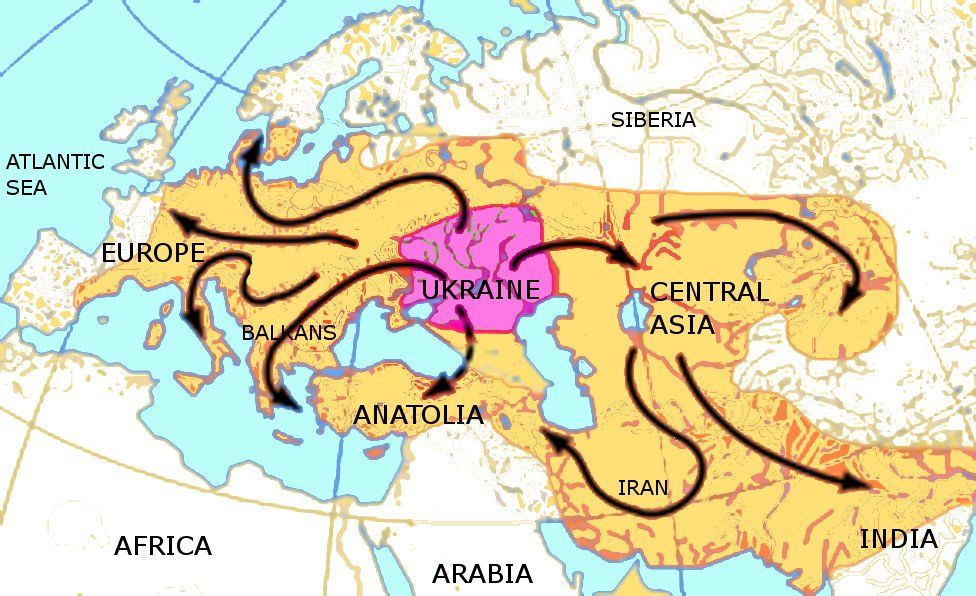
cradle of the Indo-Europeans according to the theory of the Kurgan.
The Indo-Europeans were a hypothetical people and there are many theories about their place of origin.The most popular is the so-called 'Kurgan theory' according to which the original cradle of the Indo-Europeans was the Pontic Steppe, north and east of the Black Sea.
The kurgan were burial mounds that have been discovered in this geographical area.
Sarmatian kurgan (4th century BC)
From this original cradle the Indo-European people spread westward to Europe and eastward,Asia Minor,Iran and India.
History of the study of Indo-European
In the 18th century philologists first noticed similarities in vocabulary and structure between Greek,Latin and Sanskrit so the theory of Indo-European homolingualism was created and started.
see also
In the link below you can see materials for learning modern Indo-European language.
The purpose of this website is, as they state, to revive Indo-European as a living and spoken language!
In fact, there you can download Indo-European lessons in a format similar to that of modern language learning methods, with dialogues, vocabulary and grammatical explanations and etymologies.
Paleo-Iberian or Iberian are the languages spoken in the Iberian Peninsula before the Romans arrived, without taking into account the languages spoken in the colonies, such as Greek and Phoenician.
With the exception of Basque, they have all disappeared and have been replaced by Latin, with the only evidence of their existence being the few inscriptions that have been found and the references in the sources.
Of these inscriptions, which date from the 5th century BC to about the 1st century AD, Iberian, Tartessian, Celtic and Lusitanian are known, while other languages are known from place names, human names and theonyms known from Greek and Latin sources.
The Iberian language
inscription in the Greco-Iberian alphabet from Alcoa
Iberian was the language of the Iberian people who, according to Greco-Roman sources, lived on the eastern and southern coasts of the peninsula.
A Greco-Iberian alphabet had even been developed which was a variant of the Ionic alphabet. Inscriptions in this alphabet have been found mainly in Alicante and Murcia.
The Iberian language is thought to have been unlike any known language of the past or present.
Celt-Iberian
Celtic was an Indo-European language spoken by the Celts of the Iberian Peninsula in the central and northern regions.It is attested by about 100 inscriptions (2nd BC-1st AD) written in the Celtic and Latin alphabets.
Of the continental Celtic languages, Celtic is less well documented than Old French but more so than Alpine and Gaelic.
the Tartessian language
Tartessian was spoken in the southwest of the peninsula and is thought to have been the language of Tartessus.
The Turdetans of the Roman period were thought to be the heirs of the Tartessian civilization and according to Strabo ''were the wisest of the Iberians with an alphabet, extensive records of their histories, poems and laws written 6,000 years ago ,as they claim.
Tartessian has not yet been categorized,and efforts are being made to classify it among the Celtic languages,but so far this theory has not been supported.
All these Paleo-Hispanic languages have left a lexicological substrate in Spanish.
Since the Hellenistic period, a Hebrew population that spoke Greek enriched with Hebrew elements emerged in the wider area of the Eastern Mediterranean, today's Greece, the Levant of the Middle East, Alexandria, Asia Minor and other places.
This population was the Romaniotes and their language was Yevanic or Judaeo-Greek.
The Romaniotes were neither Ashkenazi nor Sephardim . They trace their origin back to the Eastern Roman Empire in the Levant long before the Empire broke up into two parts.They were Greek speaking already at the time.
Yevanic quadratic script in a 10th-century Greek-Jewish glossary (Leningrad Public Library)
The name of the language comes from Yavana -the Hebrew name for Greeks and they used the Hebrew script for their language.
Yevanic survived until about World War II ,the German occupation which brought about the decimation and emigration of most Romaniotes to the United States and Israel.
Sephardim were an easier target for the Nazis than the Romaniotes for the reason that the former , coming from Spain, spoke Ladino , Spanish with Hebrew elements, as their mother tongue.
The accent that the Sephardic Jews spoke in Greek was distinctive, somewhat singsong like their Spanish and they could be distinguished more easily.In contrast, the Romaniotes had Greek as their mother tongue and were more indistinguishable.
Today,in Greece, the remaining Romaniotes are indistinguishable from the Sephardim as a community and together they number between 3 and 4 thousand.
A very well known member of the Romaniotes community was the Greek Army officer Mordechai Frizis, who distinguished himself in the 1940s war with the Italians.
The Romaniotes colonel of the Greek army (1893-1940).
The history of Yevanic Greek starts from a very old time, from the Hellenistic era and comes from the common Greek, the Alexandrian.
In addition it includes several influences of Hebrew and was written in the Hebrew alphabet.
Texts from the Hellenistic period in the Hebrew alphabet are almost non-existent from Greece and Asia Minor; however, there are some from Magna Grecia in Italy.
The Akkadian language (akkadītum, lišānum, ak.ka.dû) , also known as Assyro-Babylonian , is an extinct Semitic language, a member of the larger linguistic Afro-Asiatic family), spoken in ancient Mesopotamia.
It is the oldest attested Semitic language. It used a cuneiform writing system derived from ancient Sumerian, a completely different isolated language.
The name of the language comes from the city of Akkad, an important Mesopotamian cultural centre.
During the third millennium BC, a very close cultural symbiosis developed between the Sumerian and Akkadian peoples, which included extensive bilingualism.
The influence of Sumerian on Akkadian (and vice versa) is evident in all areas, from lexical borrowings on a massive scale, to syntax, morphology and phonological convergence.
This has led scholars to refer to Sumerian and Akkadian in the third millennium as a language union (Sprachbund).
Akkadian is first attested in Sumerian texts in nouns from about 2800 BC and from the second half of the third millennium BC texts written entirely in Akkadian begun to appear.
Hundreds of thousands of texts and text fragments have been excavated to date revealing a broad literary tradition from mythological narratives, legal texts, scientific works, correspondence and many other fields.
By the second millennium BC, two different forms of the language were in use in Assyria and Babylonia (known as Assyrian and Babylonian, respectively).
Akkadian was for centuries the lingua franca in the ancient Near East. However, it began to decline around the 8th century BC and was marginalized by Aramaic.
By the Hellenistic period, the language was mostly restricted to use by scholars and priests working in temples. The last Akkadian cuneiform document dates to the 1st century AD.
the writing system
A cuneiform writing system was used for writing Akkadian script, which the Akkadians borrowed from the Sumerians.
It was written using a wedge which was pressed onto wet clay.The writing consisted of a combination of ideograms and symbols representing a syllable.
This writing had several problems; the same symbol was used several times to denote more than one syllable even within the same word.
Also the same symbol was used either as a logogram or as a syllable.There were no spaces between words and some specific anaphoric words were used to indicate the category of a noun.
E.g. the word mātu (country) in front of country names,or the word ilum (god) in front of god names.
Мне было 14. Я шла с тренировки через парк. Некому мудаку лет 25 приспичило неожиданно устроить мне прощание с девственностью. У него перелом челюсти, а у меня девственность на месте и заявление о нанесении вреда здоровью средней степени тяжести. Благо в милиции разобрались и заставили его заявление забрать. Ибо нехер пытаться насиловать девочку, которая идет с тренировки по русскому рукопашному бою.
farewell to virginity
I was 14. I was walking through the park from practice. Some asshole about 25 suddenly had to give me a farewell to my virginity. He had a broken jaw, but my virginity was still there and I received a moderate injury report. Fortunately, the police sorted it out and made him withdraw his statement. Because you shouldn't try to rape a girl who was coming from Russian martial arts training.
The Latin Alphabet & the Latin Language: The Script that Conquered the World
The Latin Alphabet & the Latin Language
Listen:
The 26 letters of the modern Latin alphabet
X
Introduction
The Latin alphabet (also called the Roman alphabet) is the most widely used writing system in the world today. It is used natively by over 4.9 billion people and as a second script by billions more.
It began around 700 BCE as a local adaptation of the Western Greek alphabet used by the Etruscans. The Romans refined it over centuries, and through conquest, Christianity, colonialism, and globalization, it became the dominant script on every inhabited continent.
Origin of the Latin Alphabet
The Romans adopted their alphabet from the Etruscans, who used a Western Greek variant brought by colonists from Euboea (Chalcis and Cumae) around 800–750 BCE.
The earliest known Latin inscription is the Duenos inscription (c. 6th century BCE) on three joined terracotta vessels found on the Quirinal Hill in Rome in 1880.
The Duenos inscription (c. 580–570 BCE) – one of the oldest known Latin texts
The original Latin alphabet had 21 letters: A B C D E F Z H I K L M N O P Q R S T V X
G was invented around 230 BCE; Y and Z were added later for Greek loanwords. J, U, and W appeared only in the Middle Ages.
The Latin Language in Antiquity
Latin began as the language of Latium, a small region around Rome. After Rome unified Italy, Latin replaced Oscan, Umbrian, Etruscan, and other local languages.
Latium – the original homeland of the Latin language
By the 1st century CE, Latin was the language of an empire stretching from Britain to Syria. Two registers coexisted:
Classical Latin – formal, literary (Cicero, Virgil, Caesar)
Vulgar Latin – everyday spoken language of soldiers, merchants, and farmers
Vulgar Latin and the Birth of Romance Languages
Vulgar Latin – the everyday spoken form of Latin used by ordinary people – gradually evolved into the modern Romance languages between the 5th and 9th centuries CE.
Geographic distribution of the Romance languages in Europe and beyond
Major Romance languages today include Italian, French, Spanish, Portuguese, Romanian, Catalan, Occitan, Romansh, Sardinian, Galician and dozens of regional varieties.
Every modern Romance language descends directly from the spoken Latin of ordinary Romans — not from the literary language of Cicero.
Global Spread of the Latin Alphabet
Today the Latin alphabet is used by more than 70% of the world’s population. Key moments:
Middle Ages → adopted for Germanic, Celtic, and most Slavic languages
Age of Exploration → carried to the Americas, Africa, Oceania
19th–20th centuries → Turkey (1928), Vietnam, Indonesia, Malaysia, Central Asia
Soviet period → briefly used for Turkic and Caucasian languages before Cyrillic
Today it is the standard script for English, Spanish, Portuguese, French, German, Dutch, Polish, Turkish, Swahili, Vietnamese, Malay/Indonesian, Tagalog, and thousands of smaller languages.
Hear Classical Latin (Restored Pronunciation)
Listen to the famous opening of Virgil’s Aeneid read in restored classical pronunciation:
Arma virumque canō, Trōiae quī prīmus ab ōrīs
Ītaliam fātō profugus Lāvīniaque vēnit
lītora, multum ille et terrīs iactātus et altō
vī superum, saevae memorem Iūnōnis ob īram…
/ˈar.ma wiˈrum.kʷe ˈka.noː …/
“Of arms and the man I sing, who first from the shores of Troy…”
Sample Text: The Lord’s Prayer in Latin
Pater noster, qui es in caelis,
sanctificetur nomen tuum.
Adveniat regnum tuum.
Fiat voluntas tua, sicut in caelo et in terra.
Panem nostrum quotidianum da nobis hodie,
et dimitte nobis debita nostra,
sicut et nos dimittimus debitoribus nostris.
Et ne nos inducas in tentationem,
sed libera nos a malo. Amen.
Our Father, who art in heaven… (the best-known Christian prayer in Latin)
Nepali or Nepalese is an Indo-Iranian language derived from a popular variety of Sanskrit. It is the official and most widely spoken language of Nepal.
Spoken by about 16 million people, mainly in Nepal, India, Bhutan, and Burma, it is written in the Devanagari script.
Geographically, it developed alongside Tibetan-Burmese languages like Nepali-Bhasa (Neguari), showing some influence from these languages.
Although Nepali is closely related to Hindi, it retains more archaic Sanskrit elements, differing from Hindi and Urdu in its lack of Perso-Arabic and English borrowings.
Name of the Language
The language was historically called Khaskura, meaning "the language of the rice growers" and was used by the Khasa kingdom that dominated present-day Nepal in the 13th-14th century.
Later, it was referred to as Gurkali or Gurkhas, named after the fierce Nepalese warriors. The British often employed Gurkhas in military operations.
Eventually, it came to be called Nepali, derived from the word Neguari, though this has been a subject of controversy as Neguari is another language.
Other names for the language include Parbatiya (Mountain Language) and Lhotsamiha (Southern Language), both used by regional groups in Nepal and Bhutan.
Writing System
Nepali has been written in a variant of the Devanagari script since the 12th century AD.
Despite being surrounded by powerful empires, Nepal has never been colonized due to its tough terrain and the fierce independence of its people.
Some Nepali Words and Phrases
नाम (naam) = Name
घर (ghar) = House
तपाईकी घर काहाँ हो? (Tapaiki ghara kaham ho?) = Where are you from?
घर घर ... हो (part of ghara ... ho) = I am from ...
तपाईंको / तिम्रो नाम के हो? (tapaiko / timro naam ke ho?) = What's your name?
नाम नाम ... हो (part naam ... ho) = My name is ...




.jpg)


.png)