Contents
The Phrygian Language
An Indo-European language of Asia Minor, closely related to Greek

Note: Click any speaker icon to hear it read aloud, click images to zoom in, or click the video to open it in a popup window.
1. Introduction: what is the Phrygian language
Phrygian was an Indo-European language spoken by the Phrygians in Asia Minor during classical antiquity, from the 8th century BC until it died out around the 5th century AD.
It was closely related to Greek — some scholars even place it, together with Greek, in a so-called "Graeco-Phrygian" branch of the Indo-European family. Phrygian is traditionally divided into two periods: Old Phrygian and New Phrygian.

An Old Phrygian inscription dedicated to King Midas, shown with a transliteration into the Latin alphabet. Click the image to enlarge.
To this day, Phrygian is attested through only a few hundred words preserved in short inscriptions. Some of these words show striking similarity to their Greek counterparts; they are not thought to be loanwords, but rather words of shared origin. More broadly, the overall structure of the language strongly recalls Greek.
2. The legend of Psammetichus and the word "bekos"
One of the best-known ancient anecdotes about the origin of the language is the experiment of the Egyptian Pharaoh Psammetichus. Psammetichus wanted to find out which language humans had spoken first.
So he gave two infants to a shepherd to raise in an isolated place, ordering him never to speak to them at all, until they uttered their first word on their own.
The word "bekos"
After some time, the children cried out the word "bekos," which in Phrygian means bread. Psammetichus concluded that the first language spoken by humans must have been Phrygian. Today, of course, this story has no scientific value for determining the language's true origin — but it remains one of the most famous ancient references to the Phrygians and their language.
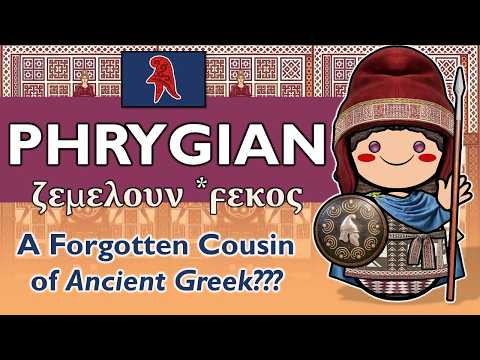
A video about the Phrygian language.
3. Origin and migration of the Phrygians
From the Balkans to Asia Minor
The Phrygians were not originally inhabitants of Asia Minor. Before migrating there, they lived in the Balkans, and according to Herodotus were called the Bryges.
Northern Epirus
A region where, according to the sources, the Phrygians originally lived before migrating to Asia Minor.
Western Macedonia
Another area of settlement, neighboring the ancient Macedonians.
Mygdonia
A region beside the Macedonians, which the Phrygians later lost when the Macedonians themselves conquered it.
According to Herodotus, the Armenians were colonists of the Phrygians.

The Phrygians while they lived in the Balkans (shown in green). Click the image to enlarge.

The core of Phrygia and the expansion of the Phrygian kingdom in Asia Minor. Click the image to enlarge.
4. Kinship with Greek and Thracian
The Graeco-Phrygian branch
Phrygian is considered a close relative of Greek. Some of its words show striking similarity to their Greek counterparts, and these are not loanwords but words of shared origin. More broadly, the very structure of the language strongly resembles Greek.
The Thracian influence
It is believed that Phrygian was influenced by the Thracian language as the Phrygians passed through Thrace on their way to Asia Minor.

Mygdonia, a region neighboring the ancient Macedonians. Click the image to enlarge.
5. Herodotus's testimony
Herodotus, in his Histories (7.73), describes the Phrygians' origin and change of name, as well as their relationship to the Armenians:
Φρύγες δὲ ἀγχοτάτω τῆς Παφλαγονικῆς σκευὴν εἶχον, ὀλίγον παραλλάσσοντες. οἱ δὲ Φρύγες, ὡς Μακεδόνες λέγουσι, ἐκαλέοντο Βρίγες χρόνον ὅσον Εὐρωπήιοι ἐόντες σύνοικοι ἦσαν Μακεδόσι, μεταβάντες δὲ ἐς τὴν Ἀσίην ἅμα τῇ χώρῃ καὶ τὸ οὔνομα μετέβαλον ἐς Φρύγας. Ἀρμένιοι δὲ κατά περ Φρύγες ἐσεσάχατο, ἐόντες Φρυγῶν ἄποικοι.
Translation: "The Phrygians' equipment was very like the Paphlagonian, with only a small difference. According to the Macedonian account, these Phrygians were called Brigians as long as they dwelt in Europe and were neighbors of the Macedonians; but when they changed their home to Asia, they changed their name also and were called Phrygians. The Armenians, who are Phrygian colonists, were armed like the Phrygians."
This account is one of the most important ancient sources for the migration of the Phrygians from the Balkans to Asia Minor, and for their relationship to neighboring peoples such as the Macedonians and the Armenians.
6. The Phrygian alphabet and inscriptions
The funerary inscription at Midas Şehri
One of the well-known Old Phrygian inscriptions is found on a tomb monument at Midas Şehri. Its text reads:
"BABA: MEME͜AIS: PROITA͜OS: KPHIJANA͜EJOS: SIKENEMAN: EDAES" — Baba, a counselor and leader from Tyana, made this dedication.
The alphabet
Phrygian was written using its own alphabet, closely linked to the early Greek alphabet and other alphabets of the eastern Mediterranean of the period.
Sources
Our knowledge of Phrygian rests almost entirely on inscriptions — funerary, votive, and other short written records — since no extensive literary texts survive in the language.

Detail of the inscription on the tomb monument at Midas Şehri. Click the image to enlarge.

The Phrygian alphabet. Click the image to enlarge.
7. Vocabulary and sample text
Below are a number of Phrygian words along with their meanings. Where a clear correspondence to an Ancient Greek word exists, it is noted alongside — these are not loanwords in either direction, but words that share a common Indo-European origin.
anar — cf. Ancient Greek ἀνήρ (anēr)
- Meaning: husband
brater — cf. Ancient Greek φράτηρ (phrátēr)
- Meaning: brother
kakoioi — cf. Ancient Greek κακόω (kakóō)
- Meaning: to mistreat
akala / bedu — cf. Thracian áchel
- Meaning: water (recalls the name of the river Achelous)
further words
- agorani: they buy
- balen: king
- bonekos: woman
- germe: warm
- gloureos: gold
- zelkia: green
- zemelos: earth (same root as "low/humble")
- ios: which/who
- kimeros: mind
- kiklen: wheel
- kynes: dog
- matar: mother
- meka: great
- onoman: name
- pateres: fathers
- podas: foot
- si: this/it
- ti-: equivalent to Greek "Zeus," meaning "the god" (genitive: tios, "of the god/Zeus")
Sample text in Phrygian
Ios ni semoun knoumanei kakoun addaket, gegeimenan egedou tios outan, akke oi bekos akkalos ti dregroun eitou autos ke oua k eroka gegaritmenos as ba tan teutous.
Translation: "Whoever does harm to this tomb, may he bring the curse of the god upon himself, and may bread and water become unpleasant for him."
8. External links
For further study of the Phrygian language, see the following sources:




0 Comments:
Post a Comment